Best Camera for Real Estate Photography (2026 Picks)
By the Plotpane editorial team · Last updated June 11, 2026 · ~12-minute read
Every listing lives or dies on its photos, and those photos start with the body in your hands. Here's the part most buying guides bury: the best camera for real estate photography in 2026 isn't one magic model — almost any current mirrorless camera will shoot a beautiful interior. What actually decides your results is which sensor format fits your budget, which wide lens you bolt to the front, and how you finish the files afterward.
Buyers overwhelmingly begin their home search online, where the listing photos are the first thing they judge (National Association of Realtors). So the camera you choose — and the editing that follows — has real money riding on it.
This is the camera-body deep dive. We deliberately skip tripods, flashes, and drones — for those, see our full real estate photography equipment guide. Below are five specific 2026 bodies across two tiers, each with a matched wide lens, plus the four specs that genuinely move the needle for interiors: dynamic range, IBIS, tethering, and the lens ecosystem behind the mount.
Quick Summary: For most real estate work in 2026, the Sony A7 IV is the best all-round full-frame pick — 33MP, the widest dynamic range of this group, and the deepest lens catalog. The Canon EOS R6 Mark II wins on handling and stabilization; the Nikon Z6 III has the best viewfinder. On a budget, the Sony a6700 is the lightest serious body and the Canon EOS R7 delivers the most resolution plus dual card slots. Whichever you buy, the files still need exposure, perspective, and window cleanup before they're listing-ready.
The short answer: the best camera for real estate photography in 2026
If you only want the verdict, here it is:
- Best overall: Sony A7 IV — 33MP, the best dynamic range of the group, the largest lens catalog.
- Best handling and stabilization: Canon EOS R6 Mark II — up to 8 stops of IBIS and the friendliest menus in the class.
- Best viewfinder and build: Nikon Z6 III — a stunning 5.76-million-dot electronic viewfinder in a weather-sealed body, often the best full-frame value in 2026.
- Best lightweight value: Sony a6700 — a 26MP crop-sensor body you'll barely feel in the bag.
- Best budget body with pro reliability: Canon EOS R7 — 32.5MP and dual card slots for under $1,500.
One honest caveat before you spend: the badge matters far less than you think. A well-lit, level, well-composed frame from a $1,400 crop body will beat a sloppy frame from a $3,500 flagship every time. Sensor format, lens choice, and clean editing move the needle — the logo on the front does not.
How we picked: we weighted real-world interior performance — dynamic range, stabilization, wide-lens options, and shoot-day reliability — over headline video specs, drawing on independent lab data from Photons to Photos and field testing reported by DPReview. We don't earn commissions on camera sales, so these picks reflect what works for listings, not what pays best.
2026 real estate camera comparison at a glance
| Camera | Sensor | Dynamic range (PDR)¹ | IBIS | Card slots | Body price² | Matched wide lens | Best for |
|---|---|---|---|---|---|---|---|
| Sony A7 IV | 33MP full-frame BSI | ~11.7 EV | 5.5 stops | 2 (CFexpress A / SD + SD) | ~$2,100 | Sony FE 16-35mm f/4 PZ G | Best overall |
| Canon EOS R6 Mark II | 24.2MP full-frame | ~11.3 EV | up to 8 stops | 2 (UHS-II SD) | ~$1,900 | Canon RF 14-35mm f/4L IS | Handheld interiors |
| Nikon Z6 III | 24.5MP full-frame (partially stacked) | ~10.6 EV | up to 8 stops | 2 (CFexpress B + SD) | ~$2,000 | Nikon Z 14-30mm f/4 S | Viewfinder & build |
| Sony a6700 | 26MP APS-C BSI | ~10.7 EV | 5-axis (~5 stops) | 1 (SD UHS-II) | ~$1,400 | Sony E 10-20mm f/4 PZ G | Lightest serious kit |
| Canon EOS R7 | 32.5MP APS-C | ~10.5 EV | up to 7 stops | 2 (UHS-II SD) | ~$1,400 | Canon RF-S 10-18mm f/4.5-6.3 IS STM | Most pixels + dual cards on a budget |
¹ Dynamic range is base-ISO Photographic Dynamic Range (PDR) as measured by Photons to Photos — a stricter, real-world figure than the "~15 stops" makers advertise. ² Approximate US street prices for the body only, as of June 2026.
The takeaway from the table: the dynamic-range spread between the best and worst body here is barely over one stop, and every one of these cameras shoots a clean, MLS-ready interior. You're choosing an ergonomics-and-ecosystem package, not a winner and four losers.
What actually matters in a real estate camera (and what doesn't)
Five things move the needle for interiors. In rough priority order:
1. Dynamic range. Interiors are brutal on a sensor: you're capturing a dim corner and a window blasting noon sunlight in the same frame. Dynamic range is how much of that brightness range the sensor records before highlights clip to white or shadows crush to black. Camera makers love to quote "15 stops," but that's an engineering measurement. The real-world, usable figure — what Photons to Photos calls Photographic Dynamic Range — lands closer to 10.5–11.7 EV for every body on this list. The honest truth: the differences are under one and a half stops, and they mostly disappear the moment you bracket three exposures for a bright window. Dynamic range is worth caring about; it's not worth losing sleep over.
2. In-body image stabilization (IBIS). A sensor that floats to cancel shake lets you shoot handheld at 1/8 second and still get tack-sharp walls — invaluable in a cramped powder room, a stairwell, or a closet where the tripod legs won't open. Canon's R6 Mark II (up to 8 stops) and Nikon's Z6 III (up to 8 stops) lead here; Sony's 5.5-stop A7 IV is a half-step behind but still plenty. You'll still want a tripod for bracketed sets, but strong IBIS turns "I can't fit the tripod in here" into a non-issue.
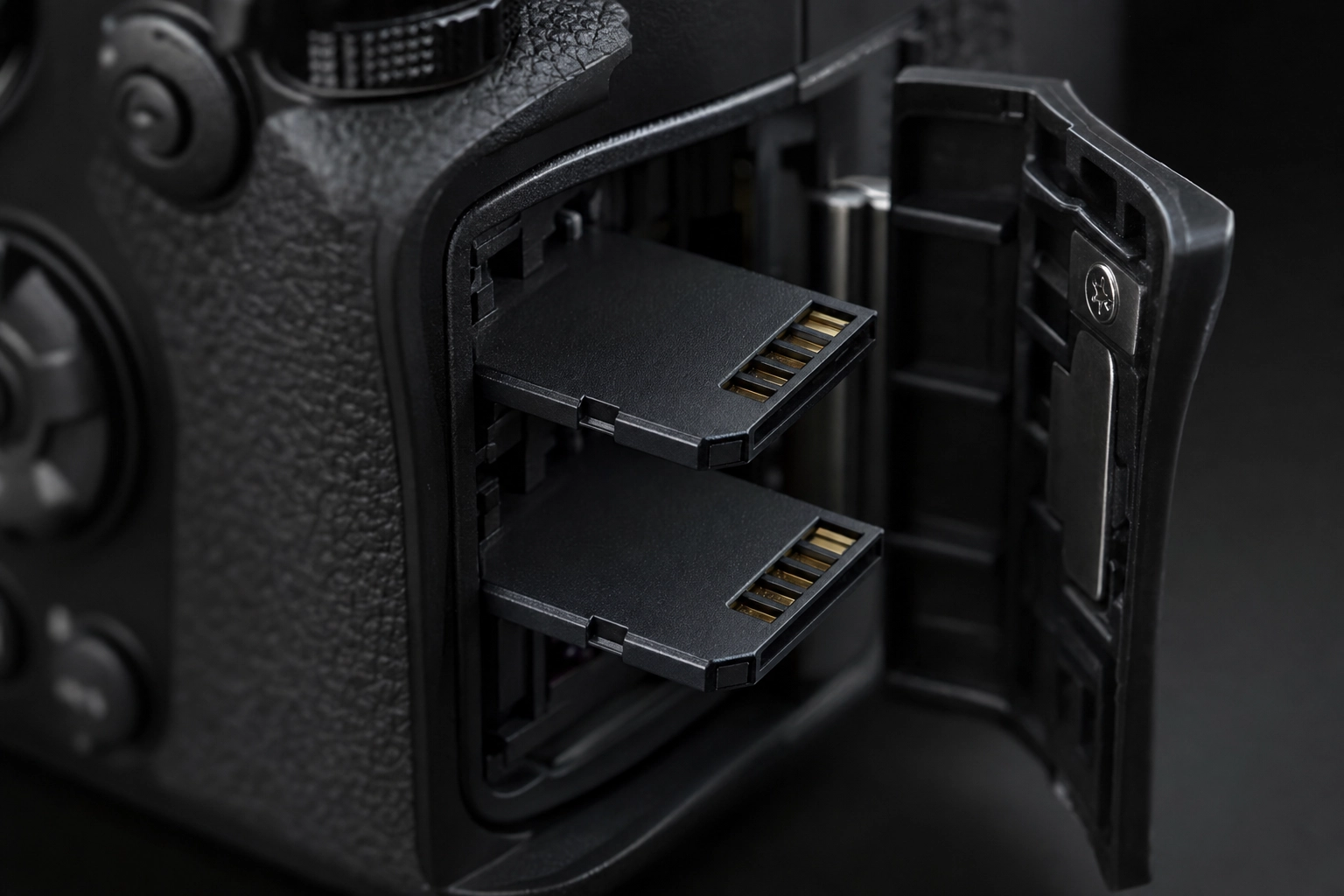
3. Tethering and dual card slots. All five bodies tether over USB-C to free software — Sony's Imaging Edge (or Capture One), Canon's EOS Utility, and Nikon's NX Tether — so you can review a frame full-size on a laptop while the client is standing in the room. More important for paid work: a second card slot writes an instant backup. A property shoot is unrepeatable — the staging gets pulled, the light changes, the seller moves out — so a card failure with no backup means losing images you can never reshoot. Four of these cameras have two slots; the a6700 has one. That single fact is the biggest reason a working pro might skip it.
4. The lens ecosystem behind the mount. Buying a body is really choosing a mount, because the wide-angle lens does the heavy lifting in real estate. The sweet spot for interiors is a 16–35mm lens on full-frame (you'll live between 16mm and 24mm), or roughly 10–20mm on an APS-C crop sensor. Don't go wider than about 14mm full-frame equivalent — past that, walls bow, and that warped, fish-eye look erodes buyer trust faster than a dim photo does. Sony's E and FE catalog is the deepest, including affordable third-party glass from Sigma and Tamron. Canon's RF and Nikon's Z lineups are excellent but pricier, and Canon's APS-C (RF-S) wide options are still thin.
5. Resolution — up to a point. Twenty-four megapixels is already more than enough for any MLS, Zillow, or brokerage site, and for prints up to roughly 16×20 inches. More resolution only helps if you crop hard or print large. That's why a 24MP R6 Mark II isn't "worse" than a 33MP A7 IV for listings — it just gives you slightly less cropping headroom in exchange for smaller files and faster editing.
What doesn't matter much: burst speed (rooms don't move), flagship autofocus (you're shooting static scenes, often manually focused), and headline video specs. Every camera here also records competent 4K video, but this guide is about stills — if you're adding walkthrough video, that's a separate kit decision covered in the equipment guide, not a reason to buy a different body.
Best full-frame mirrorless cameras for real estate
Full-frame gives you the widest field of view per focal length, the best low-light performance, and the most tonal latitude for recovering shadows and windows. It's the professional default for a reason.
One bit of 2026 context first, because it saves you money: Sony has since launched the A7 V and Canon the EOS R6 Mark III. Those newer bodies are excellent, but their arrival pushed the A7 IV and R6 Mark II into value-buy territory — you're getting last year's flagship for hundreds less, with image quality that's still completely current for listings.
Sony A7 IV — best overall for real estate photography
The specs that matter: a 33MP full-frame BSI sensor, ~11.7 EV of real-world dynamic range (the best of this group), 5.5-stop IBIS, dual card slots, and a fully articulating screen. Body around $2,100 in mid-2026.
Matched wide lens: the Sony FE 16-35mm f/4 PZ G (about $1,200) is the value workhorse — light, sharp corner-to-corner, with a handy power zoom. Step up to the FE 16-35mm f/2.8 GM II if budget allows, or save with the third-party Tamron 17-28mm f/2.8.
Why it wins for real estate: the A7 IV pairs the highest resolution here with the widest dynamic range and, crucially, the deepest lens ecosystem on the planet — including cheap, excellent wides from Sigma and Tamron. The 33MP files give you real cropping and large-print headroom, and the USB-C tether is rock-solid for client-present shoots.
The catch: the newer A7 V offers 7.5-stop IBIS for around $2,900 if stabilization is your priority, and those 33MP RAW files are larger to store and edit than a 24MP body's. For listings, neither is a dealbreaker.
Canon EOS R6 Mark II — best handling and stabilization
The specs that matter: a 24.2MP full-frame sensor, up to 8 stops of IBIS (the best stabilization in this lineup), dual UHS-II SD slots, fast and reliable Dual Pixel autofocus, and Canon's much-loved color science straight out of camera. Body around $1,900 — and falling, now that the R6 Mark III is out.
Matched wide lens: the Canon RF 14-35mm f/4L IS USM (about $1,699) is the modern real-estate workhorse — that extra 2mm at the wide end is genuinely useful in tight rooms. The compact RF 16-28mm f/2.8 IS STM (~$549) is a superb-value alternative; the RF 15-35mm f/2.8L IS is the premium option.
Why it wins for real estate: nothing here handles better. The menus are the most intuitive in the class, the grip is superb, the 8-stop IBIS makes handheld interiors trivial, and the dual SD slots give you that all-important in-camera backup. Canon's autofocus locks confidently even in dim rooms.
The catch: at 24MP it has the least resolution of the full-frame trio (still plenty for listings), and Canon's RF wide-angle lineup is narrower and pricier than Sony's. The newer R6 Mark III (32.5MP) is the step-up if you want more pixels, but the Mark II is the smarter value today.
Nikon Z6 III — best viewfinder and build
The specs that matter: a 24.5MP partially-stacked full-frame sensor, up to 8 stops of IBIS, a class-leading 5.76-million-dot electronic viewfinder, dual slots (one fast CFexpress Type B, one SD), and a rugged weather-sealed body. Around $2,000 in 2026 — one of the best full-frame values going.
Matched wide lens: the Nikkor Z 14-30mm f/4 S (about $1,297) is a near-perfect real-estate lens — compact, sharp, and rare among ultra-wides in that it takes standard screw-on front filters. The Z 14-24mm f/2.8 S is the premium choice.
Why it wins for real estate: that big, bright electronic viewfinder is the best tool here for nailing level horizons and straight verticals in the moment, the build feels indestructible on a busy shoot day, and DPReview rates its all-round ability at the top of the mid-range full-frame pile. Eight-stop IBIS and a fast sensor readout round it out.
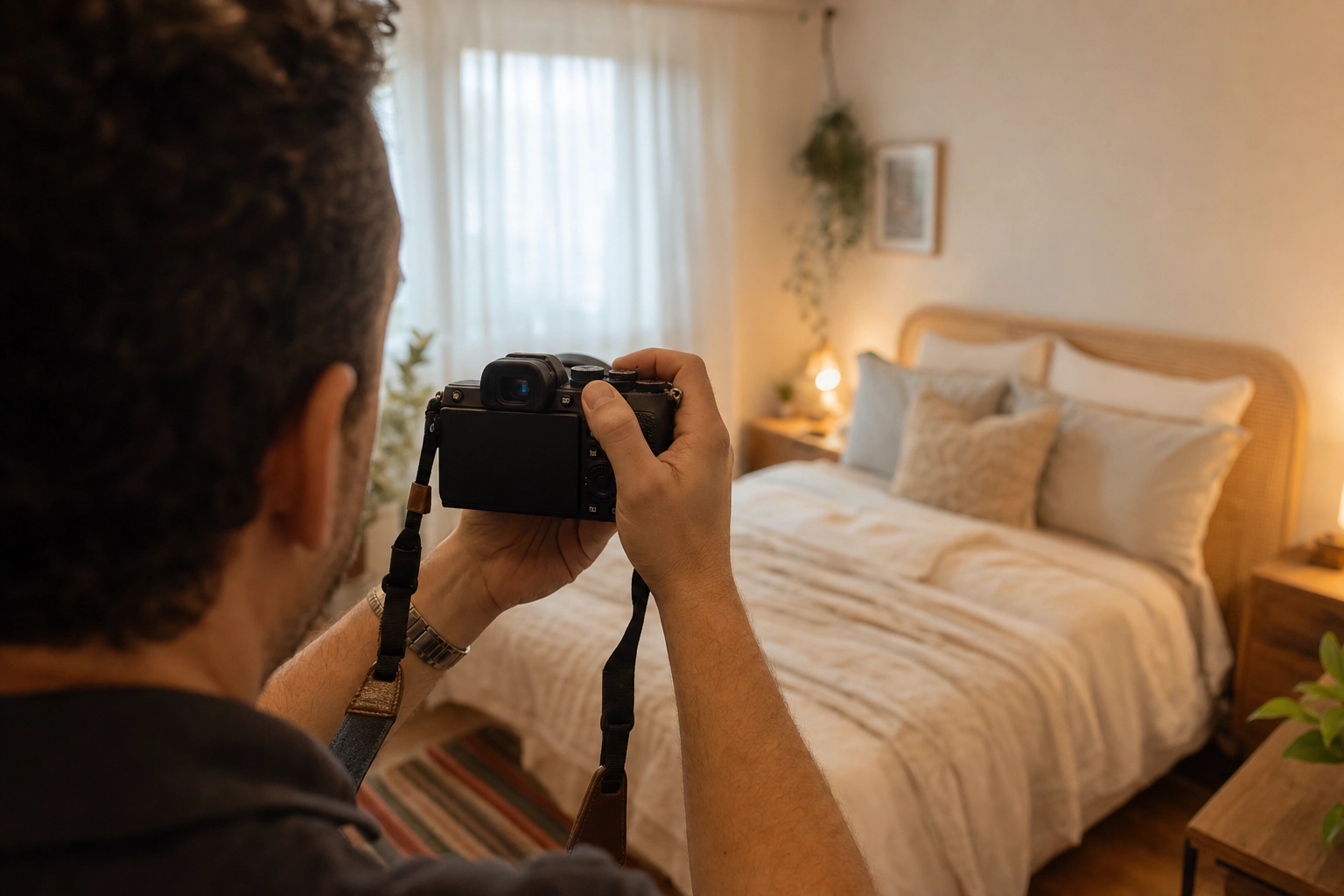
The catch: the partially-stacked sensor trades a little base-ISO dynamic range for its speed — WIRED's review flags "less dynamic range in photos than competitors," and lab data puts it around 10.6 EV, modestly behind the A7 IV. For real estate that's a non-issue: bracket three frames for bright windows and the gap vanishes entirely.
Best budget and crop-sensor cameras for real estate
Modern APS-C (crop-sensor) bodies have closed most of the image-quality gap with full-frame. The only real catch is geometry: a crop sensor multiplies focal length by about 1.5×, so you need a true ultra-wide — a 10–20mm lens — to get full-frame-equivalent coverage. Get that right and either of these cameras delivers professional listings for well under $2,000 all-in. These are the best budget cameras for real estate photography in 2026.
Sony a6700 — best lightweight value
The specs that matter: a 26MP APS-C BSI sensor, 5-axis IBIS, Sony's class-leading subject-tracking autofocus, and a genuinely pocketable body. About $1,400.
Matched wide lens: the Sony E 10-20mm f/4 PZ G (about $748) is the matched ultra-wide — feather-light and sharp, giving you roughly 15–30mm full-frame coverage. The Sigma 10-18mm f/2.8 is a brighter-aperture value alternative.
Why it works for real estate: it's the lightest serious camera here, it taps into the enormous E-mount catalog (including affordable Sigma and Tamron lenses), and its files are excellent. For a solo agent shooting their own listings, it's the easiest "real camera" to actually carry.
The catch: a single card slot, so there's no in-camera backup. For a hobbyist or agent that's fine; for a working pro shooting unrepeatable jobs, it's the one compromise that gives serious shooters pause.
Canon EOS R7 — most resolution and dual cards on a budget
The specs that matter: a 32.5MP APS-C sensor (the most pixels of the budget pair), up to 7 stops of IBIS, and — unusually for the price — dual UHS-II SD card slots. Around $1,400, often less on sale.
Matched wide lens: the Canon RF-S 10-18mm f/4.5-6.3 IS STM (about $329–400) is light, cheap, stabilized, and gives roughly 16–29mm full-frame coverage — the exact interior sweet spot. It's the lens that can genuinely start a real-estate side business.
Why it works for real estate: you get pro-grade dual-card reliability and the highest resolution of any body here, full-frame or crop, at a budget price. For agents who want backup security without spending two grand, it's the standout value.
The catch: the 1.6× crop and a still-thin RF-S wide lineup limit your ultra-wide choices to essentially that one 10-18mm zoom (or adapted EF-S glass), and high-ISO performance trails full-frame in very dim rooms — easily solved with a tripod and bracketing.
Full-frame vs APS-C for real estate: which should you buy?
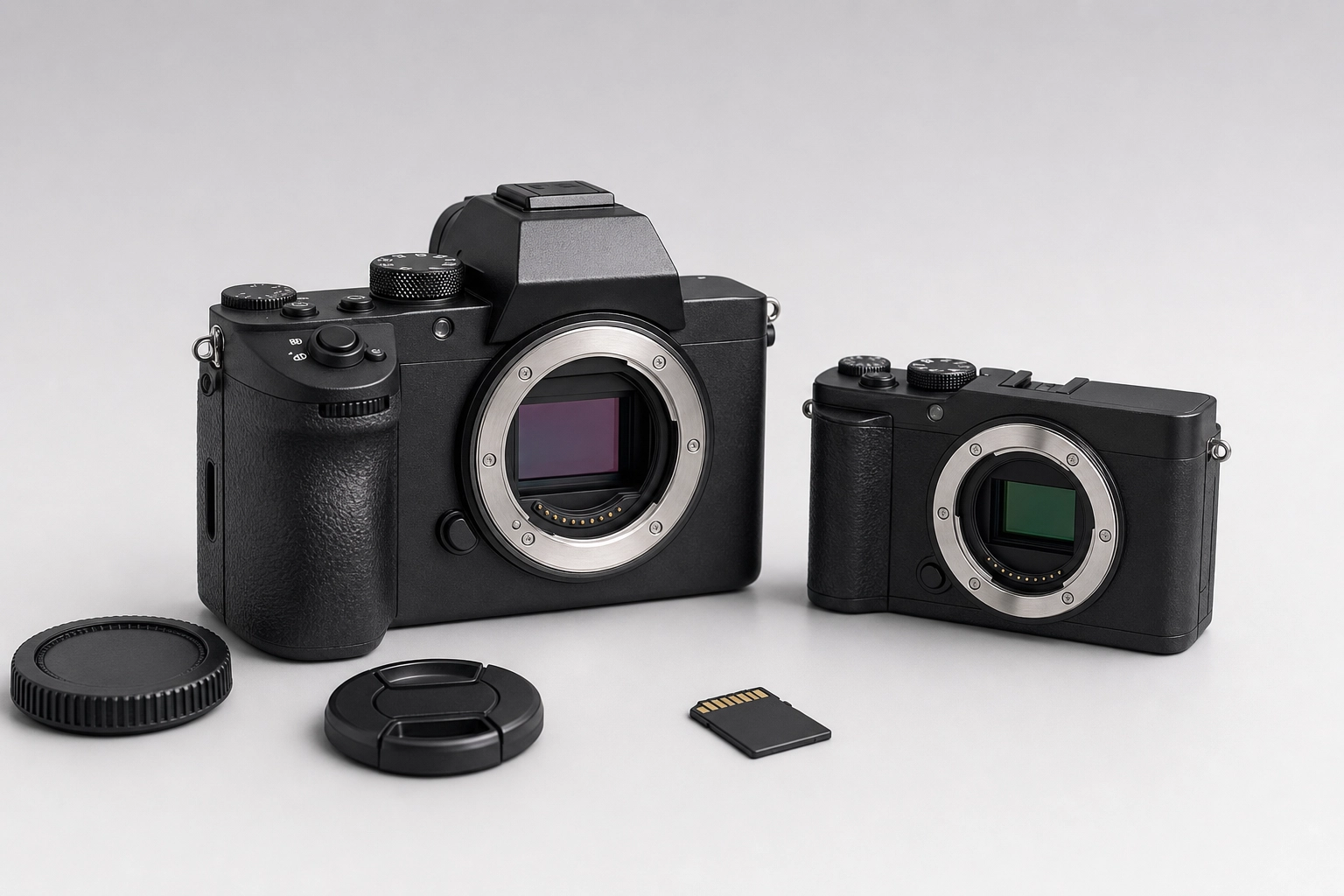
This is the question behind every "best camera" search, so let's settle it without dogma. If you want the best mirrorless camera for real estate in a single sentence: go full-frame if you shoot daily, APS-C if you're starting out or watching the budget.
Buy full-frame if you shoot listings daily or professionally, you want the most low-light latitude and the cleanest shadow recovery, or you'll crop hard and print large. The wider native field of view also means you can use slightly less extreme (and better-corrected) lenses to fill a room.
Buy APS-C if your all-in budget is under about $2,000, you value a light kit you'll actually bring everywhere, and your photos mostly live on the web and the MLS. Just commit to a real 10–20mm ultra-wide — a standard 16-50mm kit lens is nowhere near wide enough for interiors.
The honest truth that pricier guides won't tell you: sensor size is a smaller factor than lighting, composition, and editing. A clean, level APS-C frame shot at f/8 will out-sell a crooked, underexposed full-frame frame every single day.
Real estate camera settings that actually work
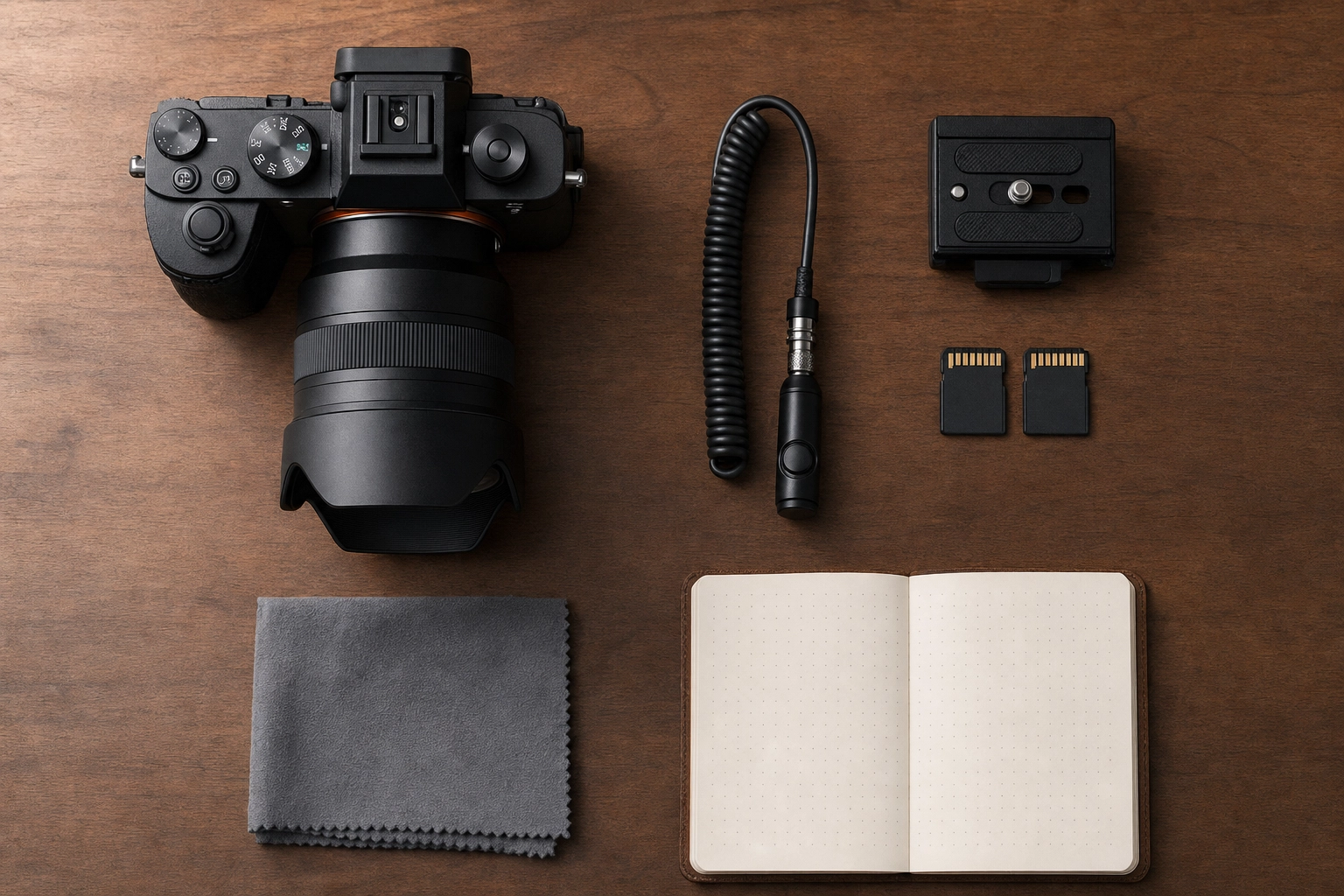
Great gear with the wrong settings still produces mediocre listings. Here's a reliable starting point you can dial in on any body above — the real estate camera settings most pros default to:
- Aperture: f/8 to f/11. f/8 is the sweet spot — enough depth of field to keep the whole room sharp, without the softening from diffraction you'll see past f/11.
- ISO: base 100. The lowest native ISO gives you the cleanest files and the maximum dynamic range. You're on a tripod, so a slow shutter is fine.
- Shoot RAW, not JPEG. RAW preserves the tonal latitude you need to recover bright windows and dark corners later.
- Tripod plus a 2-second timer or remote release. This eliminates shake entirely and locks your framing between bracketed frames.
- Single-point autofocus (or manual focus) about a third of the way into the room. Don't let the camera guess; place the focus point deliberately.
- Turn on the electronic level and keep the sensor plane vertical. Tilting up or down makes walls lean inward — the classic "keystone" look. Keep the camera level and you'll save yourself a correction later.
- Bracket 3–5 frames at ±2 EV for bright windows. This is the foundation of the HDR and "flambient" techniques that tame a sunny window without blowing it out.
- Set one consistent white balance for the whole listing, so every room matches when the gallery goes live.
For a deeper field workflow — flash, flambient, and shot lists — see our listing photo guide.
Should you buy a camera at all — or hire and edit smarter?
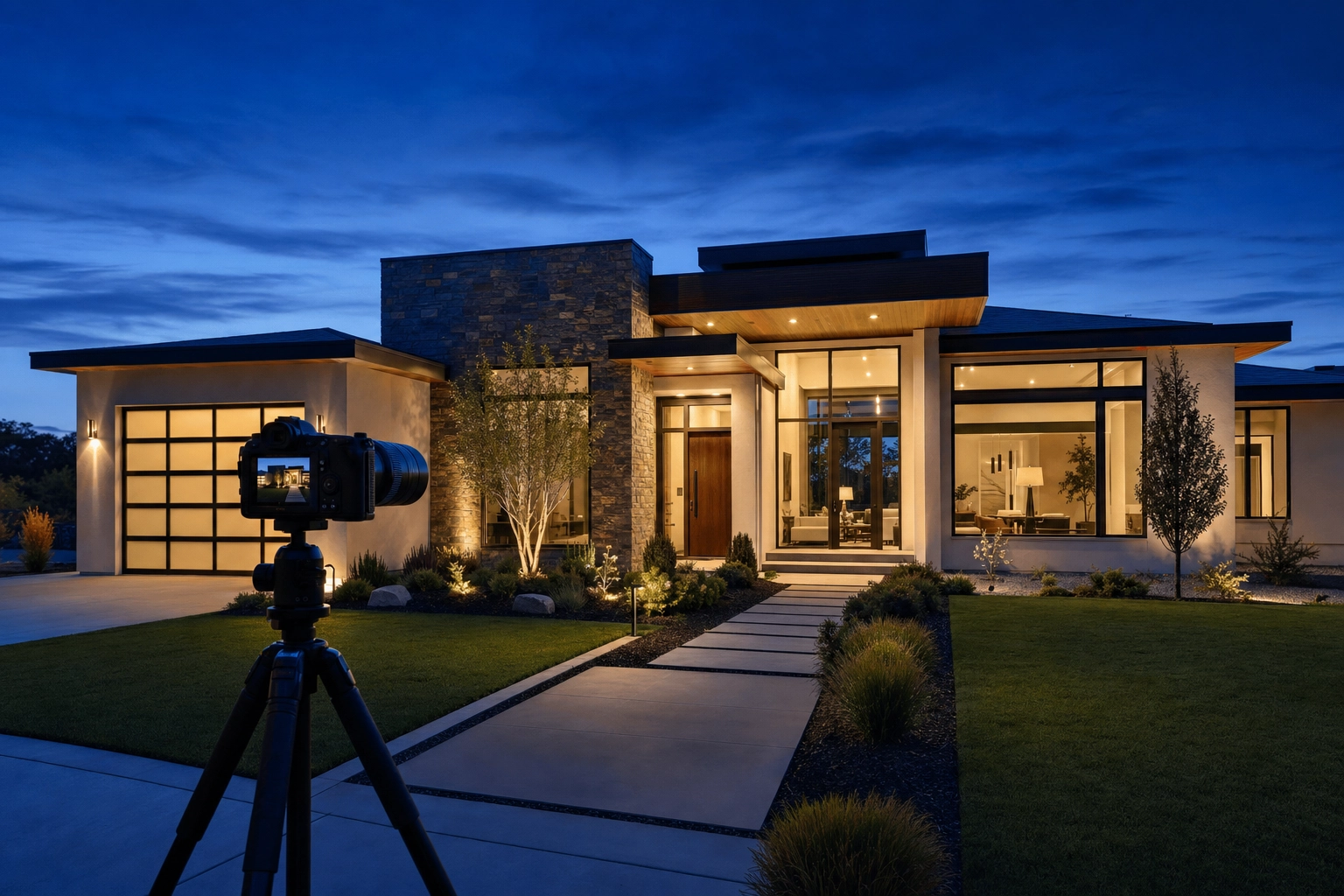
Run the math before you spend. A professional listing shoot typically costs a few hundred dollars per property, while a capable body-plus-wide-lens kit runs roughly $2,000–4,000 once you add a tripod. (We break down the rates in detail in what real estate photographers charge in 2026.)
The rule of thumb: buy if you shoot enough volume that a camera kit pays for itself in a handful of listings; hire if you only list occasionally and want guaranteed results. If you shoot for others, the volume economics change again — that's the world we built our tools for high-volume real estate photographers around.
Either path leads to the same place, though: raw files that aren't ready to publish yet.
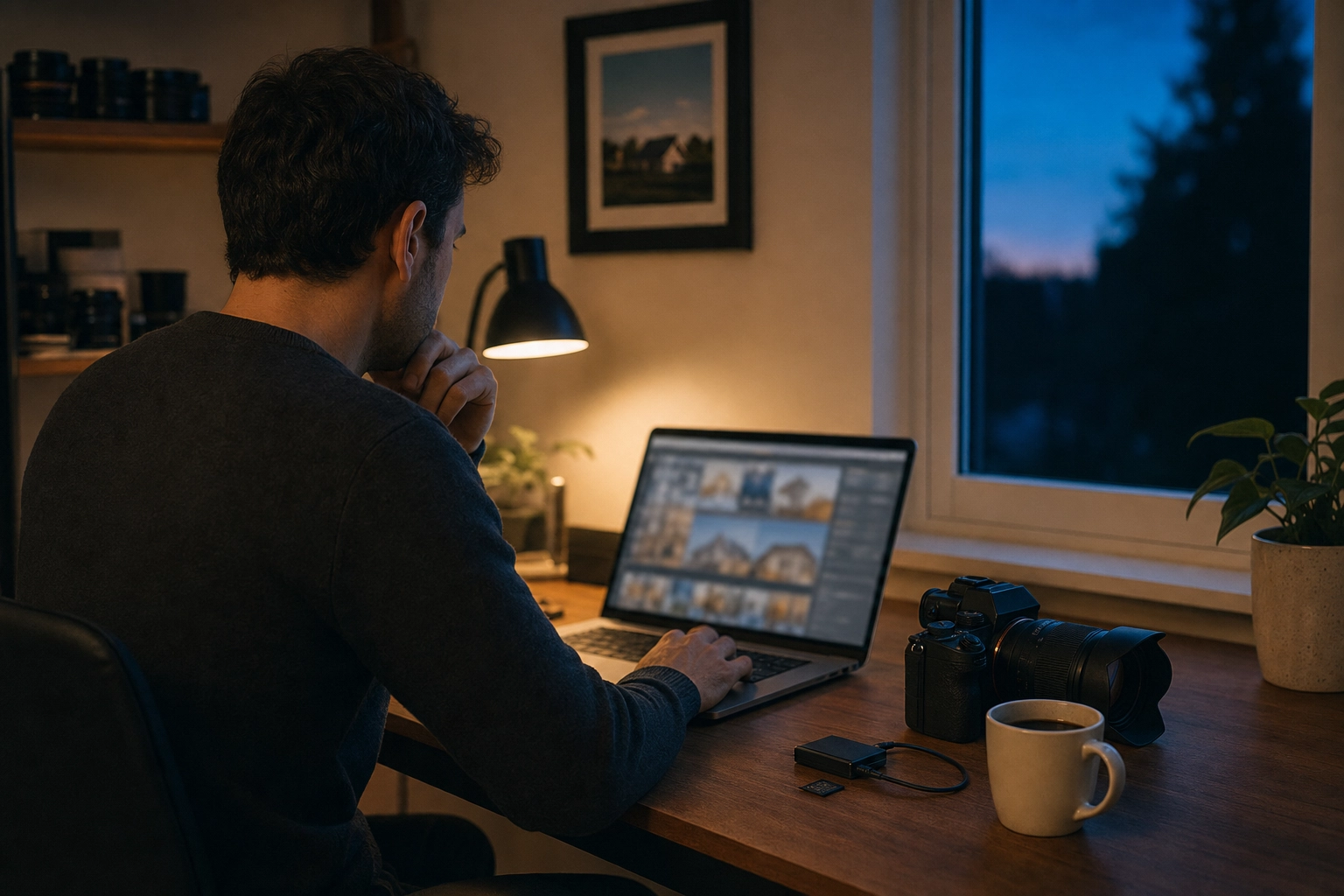
The editing reality: even the best camera needs cleanup
Here's the truth no camera spec sheet admits: every body on this list ships RAW files that still need work before they're listing-ready. Windows are too bright, shadows are too dark, the white balance drifts between rooms, and even with careful technique, verticals need a nudge. That post-shoot editing — not the camera — is what separates a snapshot from a scroll-stopping listing photo.
That's the gap Plotpane closes. Upload the frames — camera RAW included, though what Plotpane reads out of a RAW is the full-size JPEG your camera already wrote inside it rather than a development of the sensor data — and Auto Enhance balances exposure, recovers blown-out windows, lifts dark corners, and corrects white balance and clarity automatically — so a clean single capture often does the job without a manual bracket-merge in Lightroom — though it works on one frame, and does not merge brackets for you. Perspective Fix straightens converging verticals so walls stand up straight without a tilt-shift lens. Shot an overcast exterior? Day-to-dusk conversions and sky swaps are each their own render on that frame, a credit apiece.
A render finishes in about two minutes, at about 2.4K on the long edge or 4.7K for a second credit, with no visible watermark on a paid plan. Critically, Plotpane is structure-preserving: it corrects the photo you actually shot and never invents walls, windows, or rooms that aren't there. It's an image tool — not a video editor, and not a text-to-image generator — built specifically for property listings. Plans start at $49/mo; see Plotpane pricing for the full breakdown.
Buy the best camera for real estate photography that fits your hands and your budget. Then let the editing turn every frame into a listing that closes.
Frequently asked questions
Do you need a full-frame camera for real estate photography?
No. Full-frame offers better low-light performance and more dynamic-range latitude, but a modern APS-C camera like the Sony a6700 or Canon EOS R7 produces fully professional listing photos when paired with a true 10–20mm ultra-wide lens. Full-frame is the better long-term investment if you shoot daily; APS-C is the smarter value if you're starting out or shooting on a budget.
What is the best budget camera for real estate photography?
The Canon EOS R7 (around $1,400) is our top budget pick because it combines 32.5MP of resolution with dual card slots for backup — a pro-grade feature that's rare at this price — and pairs with the inexpensive RF-S 10-18mm wide lens. The Sony a6700 is the better choice if you prioritize a lighter body, class-leading autofocus, and the widest selection of affordable lenses.
Is a mirrorless camera better than a DSLR for real estate photography?
For new buyers in 2026, yes. Mirrorless cameras show a live exposure preview and an electronic level in the viewfinder — a real advantage for nailing straight verticals — and offer in-body stabilization plus the newest lens designs. Industry surveys show the majority of working pros have already switched. A DSLR you already own can still shoot excellent listings, so there's no urgency to replace a working kit, but every camera we recommend here is mirrorless.
How many megapixels do you need for real estate photos?
Twenty-four megapixels is plenty. It exceeds the requirements of every MLS, Zillow, and brokerage website and prints cleanly up to about 16×20 inches. Higher-resolution bodies like the 33MP Sony A7 IV or 32.5MP Canon EOS R7 only help if you crop aggressively or print very large — otherwise they just create bigger files to store and edit.
What are the best camera settings for real estate photography?
Shoot in RAW at base ISO 100, with an aperture of f/8 to f/11 for front-to-back sharpness. Mount the camera on a tripod, use a 2-second timer or remote release, keep the sensor plane level to avoid leaning walls, and bracket three to five exposures (±2 EV) so you can balance bright windows against darker interiors. Set one white balance for the entire listing so every room matches.
Do I need a camera that shoots video for real estate listings?
Not for stills-based listings, which is what the photos on the MLS and Zillow are. Every body in this guide happens to shoot capable 4K video, but you don't need to choose a camera based on video specs to produce great listing photos. If you plan to offer walkthrough video tours as a separate service, that's a distinct gear decision — and Plotpane itself is an image-only tool, so this guide stays focused on what makes a still photograph sell a home.