Why historic property needs a different photographic approach.
The modern listing photo — wide lens, evenly lit, HDR-balanced, neutralized white balance — is optimized for the suburban single-family home. Run that pipeline against a Queen Anne Victorian and you strip out every feature the buyer is actually there to see. The crown molding flattens. The picture rail disappears. The intentional deep color of the parlor reads as a tungsten bias that needs correcting, and the “correction” kills the room.
Historic-home photography is, in the best sense, subtractive work. You expose, correct, and enhance less than you would on a modern listing. The job is to let the architecture show, not to hide its age behind an aggressive filter.
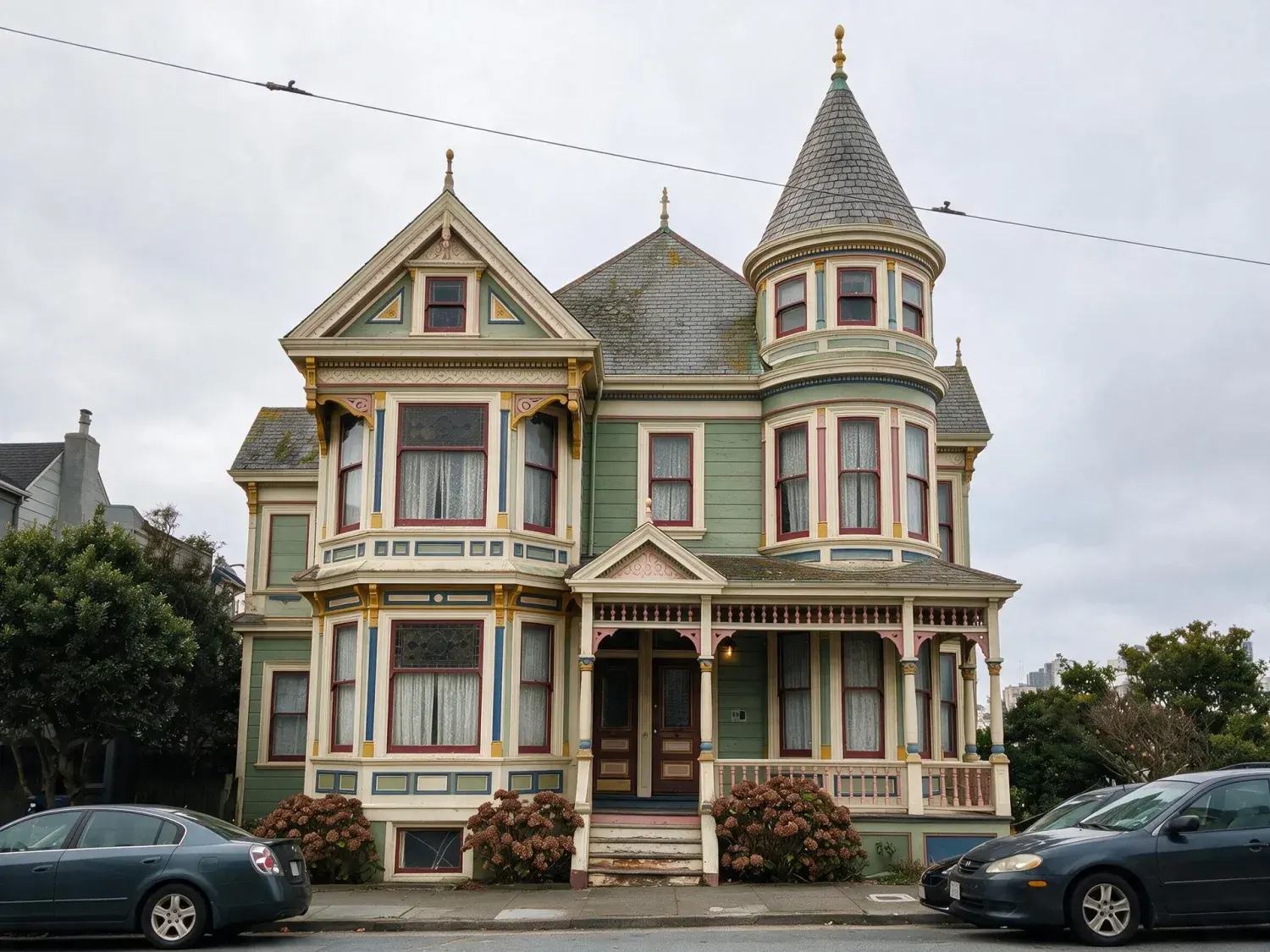
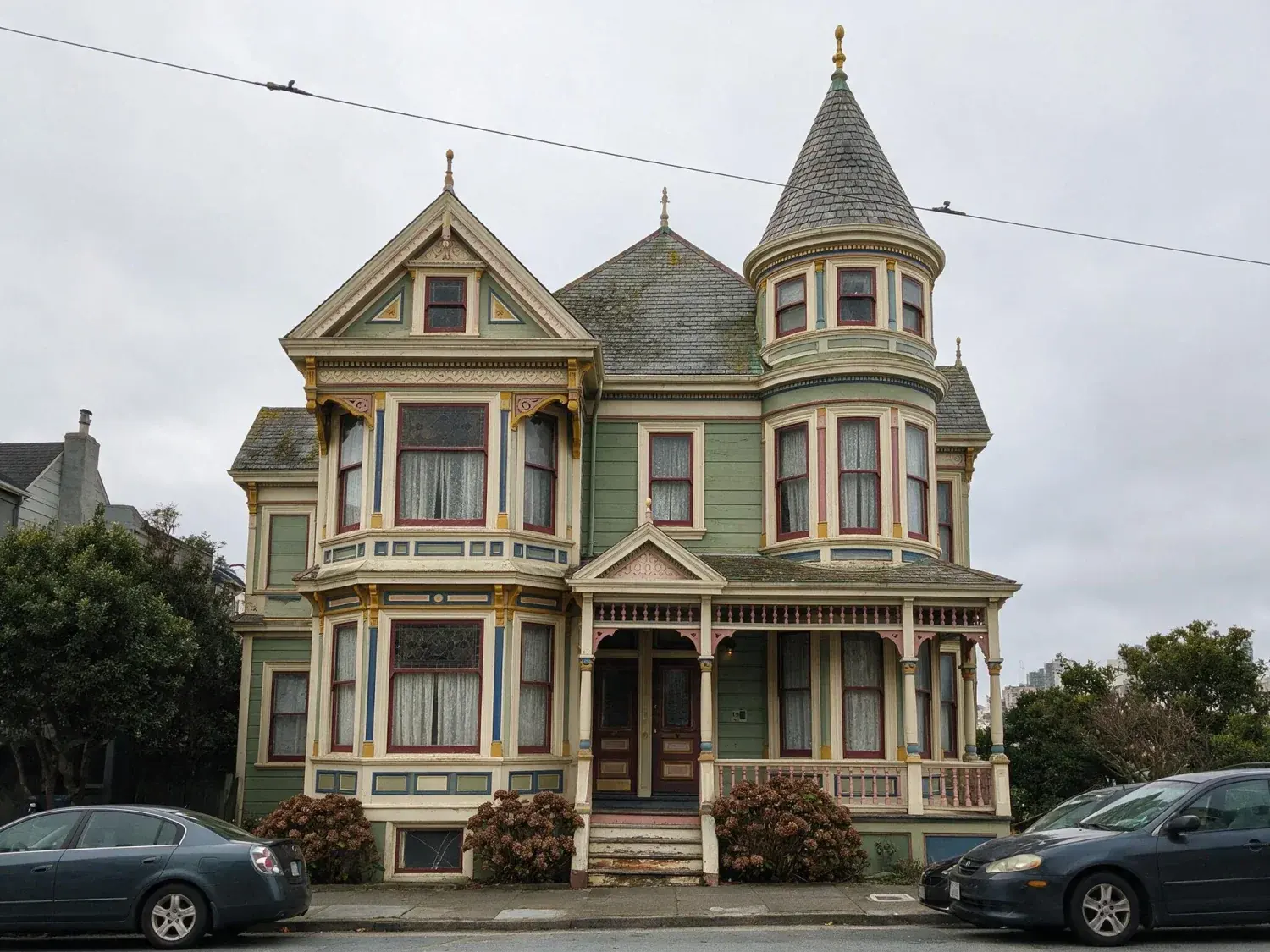
The five common American historic eras, each one in detail.
Victorian (c. 1837–1901)
- What defines it
- Ornate trim, turret rooms, stained-glass transoms, picture rails, pocket doors, deep saturated interior colors (olive, ox-blood, mustard).
- Photographic challenge
- The photographic challenge is detail density. Victorian interiors carry fifty decorative elements per wall — dentil moldings, wainscoting, plaster medallions, anaglypta wallpaper — and a blunt HDR pass smears them into mush. The challenge exterior is the cornice; long eaves + deep porch shadows + ornamental roof trim create a dynamic range your camera almost cannot hold.
- Preset / transformation
- Historic · preserves molding micro-contrast, holds deep interior chroma without the brown cast auto-WB usually adds, softens the tonal curve so the cornice doesn’t fall to black.
- Avoid
- Don’t sharpen globally — it haloes the crown molding. Don’t desaturate; those rich wall colors are the feature, not the problem.
Federal (c. 1780–1830)
- What defines it
- Symmetrical five-bay façades, flat fanlight over the door, slender Palladian windows, restrained neoclassical interior trim, soft-white or pale plaster walls.
- Photographic challenge
- Federals are subtle. The architectural story is proportion — bay spacing, window rhythm, door centering — and any perspective distortion (lens tilt, keystone) destroys it within half a degree. The interior challenge is the narrow entry hall, typically too tight for a 16mm wide.
- Preset / transformation
- Historic · light hand. Preserve the chalk-white plaster. Keep verticals pin-perfect; the symmetry is the architecture.
- Avoid
- No sky-replacement clichés (dramatic storm sky behind a Federal reads as a Halloween card). No warm-golden dusk conversion; the era wants cool, clear, controlled light.
Tudor Revival (c. 1890–1940)
- What defines it
- Steep cross-gables, half-timbering, tall narrow multi-paned casements, decorative chimneys, arched entryways, heavy stonework around the door.
- Photographic challenge
- Tudors live or die on the half-timbering contrast. The dark timber against light stucco is the identity, and it’s the first thing blown out by an aggressive HDR tone map. The interior challenge is the small leaded-glass casements — they flood interiors with patterned light that stock auto-exposure flattens.
- Preset / transformation
- Historic · protect the timber/stucco contrast ratio, hold the warm-brown chroma, let window-lead patterns show as shadows on the floor rather than being erased.
- Avoid
- Don’t sky-swap aggressively; Tudor + cloudless cyan looks wrong. Overcast or soft-cloud replacements suit the architecture.
Craftsman / Arts & Crafts (c. 1905–1930)
- What defines it
- Low-pitched gable roof, exposed rafter tails, tapered porch columns on stone plinths, built-in cabinetry, picture rails, honeyed quarter-sawn oak interiors.
- Photographic challenge
- The deep covered porch is a photographic trap — it sits 4–5 stops darker than the façade. The interior trap is the quarter-sawn oak, which carries a strong warm cast that fights sRGB. Over-correcting white balance turns the oak grey; under-correcting tints the walls orange.
- Preset / transformation
- Historic · or a custom “Warm Oak” variant. Bracketed HDR pull on the porch, tungsten-aware WB for the interior, preserve the rafter-tail shadows.
- Avoid
- Don’t straighten out the rafter tails or flatten the porch beam — that’s the architecture. Don’t recolor the oak to match modern taste.
Colonial Revival (c. 1880–1955)
- What defines it
- Symmetrical two-story façade, side-gabled roof, paired chimneys, fanlight or sidelight entry, white or pastel clapboard siding.
- Photographic challenge
- Photographically the forgiving era. The challenge is making a common style look specific — there are a million Colonial Revivals in every US suburb and the listing photo needs to distinguish this one. Dusk conversion helps; twilight on a white clapboard façade with glowing eight-over-eight windows is a genre of its own.
- Preset / transformation
- Auto Enhance + Day-to-Dusk. The era wants the warm-golden treatment, not the cool-blue.
- Avoid
- Don’t over-clutter with virtual staging if the interior is already tastefully furnished — Colonial Revival interiors tend to read best light and uncluttered.
Shooting rules, on site.
- Shoot at 20–24mm, not wider. 16mm distorts ornamental moldings into cartoon bulges at frame edges. Pros shoot historic interiors at 20–24mm and step back instead of reaching for 14mm.
- Bracket five exposures, not three. Deep porches, leaded-glass windows, and painted-lady color palettes exceed the dynamic range of most single exposures. Shoot at -2/-1/0/+1/+2 and blend manually in post.
- Tripod, always. Perspective correction on a handheld shot pulls pixels enough to soften the intricate trim. Tripod + shutter release keeps the moldings crisp.
- Shoot period-correct hours. Victorian and Tudor exteriors look best in raking late-afternoon light that carves out the trim. Federals read best in flat midday. Colonial Revivals forgive almost anything.
Editing rules — the hard ones.
Virtual staging and enhancement on historic property is a minefield. Two firm rules.
Rule 1 — Never digitally restore.
If the plaster is cracked, show it. If the paint is peeling, show it. If the original hardwood has wear, show the wear. A photograph that erases the honest condition of a historic property is both unethical and, under NAR Article 12 and California’s AB 853, a disclosure violation. The buyer is not being told the truth about what they’re buying.
This applies equally to the exterior. Do not remove peeling paint in post. Do not re-roof a house in Photoshop. Do not sky-swap to hide a sagging porch roof line. If the property needs work, the photo needs to reflect that.
Rule 2 — Staging only, and only in empty rooms.
Virtual staging in a historic home is fine when the room is empty. Stage in period-appropriate style (Craftsman-era furniture for a Craftsman home, not mid-century modern) and disclose per MLS rules. Do not use virtual staging to hide existing furniture or to “upgrade” a seller’s dated but present furnishings — that crosses into material misrepresentation.
Day-to-dusk is fine on the exterior and does not require virtual-staging-level disclosure. Sky replacement is fine unless it’s used to hide a real condition (water stain on the roof, missing shingles).
How Plotpane’s Historic preset is built.
Plotpane’s Auto Enhance runs a different pipeline when the scene is detected as an historic property. Specifically:
- Sharpening is frequency-separated so crown moldings and dentil trim get local contrast without halos.
- The tone curve keeps a shallower mid-tone so deep interior chroma (olive, ox-blood, peacock) isn’t flattened to beige.
- Perspective correction is softer than the default, because a handful of historic façades were never built perfectly plumb and “fixing” them to digital plumb looks uncanny.
- Picture rails, dado rails, and wainscoting lines are preserved as explicit features during de-noise — on the default pipeline they often soften to mush.
The listing sequence for an historic home.
The 25-photo MLS walk is different for historic property. Recommended order:
- Hero exterior — either raking afternoon light or a considered dusk conversion.
- Front-door and entry-porch detail — ornamental trim is the era signature.
- Foyer — sets the interior character. Spindle banisters, tile floor, pocket doors.
- Parlor / living room — period colors, fireplace detail, window treatment.
- Formal dining — the room most likely to sell the period charm.
- Kitchen — disclosure moment. If it’s been updated, show that. If it hasn’t, show that too.
- Staircase looking up — always a genre shot in Victorian and Federal interiors.
- Primary bedroom — show the fireplace, the millwork, the original doors.
- Secondary bedrooms — two to three frames.
- Bathrooms — honest, including any surviving original fixtures.
- Outdoor — porch, garden, carriage house.
- Detail shots — three to five that feature the specific architectural pieces that make this house this house.
Related reading.
Plotpane’s Historic preset is tuned for the architecture most listing photography tools flatten into mush. Crown molding stays crown molding.