Real Estate Photo Editing Outsourcing or AI? 24h vs 2 Min
If you shoot more than a couple of listings a week, the question isn't whether to stop editing at 10 p.m. It's who takes the work: a human editor in another time zone, or software you run yourself. Real estate photo editing outsourcing still wins two jobs outright: blending bracketed exposures and hand-built composites. AI wins most of the rest on the three numbers that run a real estate photography business: cost per image, turnaround and consistency across a set.
Every figure below comes from a published 2026 rate card or pricing page, checked in October 2026, and every calculation shows its working.
If you want the broader map of outsourcing options first, our outsourcing overview covers them. This page is about choosing between those services and an AI pipeline such as Plotpane's Auto Enhance, which renders a listing photo in about two minutes on a flat monthly plan.
Quick Summary: Outsourced real estate photo editing costs about $1–$2 per standard image, $5 per day-to-dusk conversion and up to $30 per virtually staged room, with a 12–48 hour wait that restarts on every revision. Plotpane works out at $0.33–$0.39 per render on annual plans used in full, about two minutes each. Outsource the bracket blends and hero composites; run the repeatable bulk through AI.
Real estate photo editing outsourcing vs AI: cost and turnaround table
Outsourcing is cheapest at very low volume and strongest on judgment-heavy frames. AI is cheapest once you pass a few dozen images a month, and it's the only route that returns a listing the same afternoon. The table compares the five ways a real estate photography business gets editing done in 2026.
| Route | Standard edit | Day to dusk | Virtual staging | Standard turnaround | One revision adds | Who owns quality |
|---|---|---|---|---|---|---|
| Fiverr or Upwork freelancer | ~$1 a photo (Fiverr gigs from $5); $18–$35 an hour on Upwork | Quoted per gig | Quoted per gig | ~1 day | Another delivery cycle | You, editor by editor |
| Per-image service (BoxBrownie list) | $2 | $5 | $30 | 24 hours, staging ~48 | Another queue cycle | The service, then you |
| Credit-based service (PhotoUp) | $1.10–$1.50 a credit, 1+ credit a photo | Varies | AI staging, 3+ credits | 12–24 hours | Another queue cycle | The service, then you |
| Dedicated offshore editor (PhotoUp) | $869–$1,769 a month; ~$0.50–$1.00 an edit at full use | Within their hours | Billed separately | Next shift | Next shift | You train them, they own it |
| Plotpane (AI) | $0.33–$0.39 a credit on annual plans | 1 credit | 1 credit | About 2 minutes an image | About 2 minutes, run by you | You, on every render |
Sources: BoxBrownie and PhotoUp published price lists, Fiverr gig listings and Upwork's photo-editor cost page, all checked October 2026. Prices exclude platform fees and rush tiers.
What does real estate photo editing outsourcing cost per image?
Outsourced photo editing costs roughly $0.50 to $2 per standard photo, depending on whether you hire a freelancer, a per-image service or a dedicated editor, and $5 to $30 per specialist edit such as day-to-dusk or virtual staging. The headline rate is rarely the whole bill, because fees, revisions and your own time sit on top.
Fiverr and Upwork freelancers
This is the cheapest route per frame. Real estate photography editing gigs on Fiverr typically start at a $5 minimum order, with standard single-exposure work listed around $1 a photo and one-day delivery. On Upwork, the platform's own cost page puts photo editors at a median of $25 an hour, typically $18–$35.
The catch is search cost. Good freelancers exist: one photographer on r/RealEstatePhotography describes the first editor they found on Fiverr as "very consistent, very fast" across a year and a half.
Fiverr real estate photo editing is a hiring process, not a product.
Managed per-image services
BoxBrownie's published list is $2 per image enhancement, $5 per day to dusk, $30 per virtually staged image and $5–$10 for item removal. PhotoUp sells credits at $1.50 on demand or from $1.10 in packs; a photo costs one credit or more and AI virtual staging three or more.
The pattern to notice: enhancement is cheap, specialist work is not. Six staged rooms at a $30 list price cost $180, more than double a month of Plotpane Pro.
A dedicated offshore editor
At volume, you can rent a person, and it's the model many real estate media companies use to scale. PhotoUp's dedicated editors run $869 a month part-time or $1,369 full-time on a 12-month term ($1,069 and $1,769 on a three-month term), which PhotoUp itself translates to roughly $0.50–$1.00 per edit when the editor is fully used. You get someone who learns your style. You also take on a contract, a training period, and months when you shoot less but still pay the same.
The fees missing from the headline price
- Platform fees. Fiverr adds a 5.5% buyer service fee plus a $3.50 small-order fee on orders under $200, under its 2026 payment terms. Upwork adds a client marketplace fee of up to 7.99% on its Basic plan, per its help center, plus a contract initiation fee of $0.99–$14.99 for each new editor you hire.
- Rush tiers. Same-day delivery costs extra at the services that offer it.
- Revisions. Usually free, never instant (see the turnaround section).
- Your time. Briefing, uploading, checking and chasing, priced in the management section below.
What does AI photo editing cost per image?
On Plotpane every render costs one credit, whatever the tool, so the per-image cost is the plan price divided by its credits: $0.39 on Starter, $0.36 on Pro and $0.33 on Agency billed yearly ($39, $79 and $199 a month for 100, 220 and 600 credits). Billed monthly, the same plans work out at $0.49, $0.45 and $0.42.
Three caveats keep that number honest:
- One tool per render. A frame that needs Auto Enhance and then a twilight conversion is two renders and two credits.
- High resolution costs a second credit. Standard output is about 2.4K; the ~4.7K export uses another credit.
- Unused credits don't roll over, and renders pause at your cap instead of billing overages.
Specialist work is where the gap opens. Virtual staging, a day-to-dusk twilight and clutter removal cost the same single credit as an enhancement, against $5–$30 per image on a per-image price list.
The break-even worksheet: three volumes, three answers
Below roughly 20 to 35 standard edits a month, outsourcing per image beats any subscription: Plotpane Starter's $39 buys 19 BoxBrownie enhancements, or about 33 freelancer edits once Fiverr's fees are added. Above that, and especially once staging or twilight work enters the mix, the flat plan wins by hundreds of dollars a month.
The worksheet assumes 30 frames a listing, every frame enhanced, one dusk cover per listing and a few staged rooms. Per-image prices are BoxBrownie's published list; the freelancer column is $1 a photo plus Fiverr's buyer fees, one order per listing, standard edits only.
| Monthly workload | Freelancer, standard edits only | Per-image service, full mix | Dedicated editor | Plotpane, full mix |
|---|---|---|---|---|
| Solo: 4 listings, 120 frames, 4 dusk, 6 staged (130 renders) | ~$141, specialist work extra | $440 | $869 part-time | $79 (Pro, 220 credits) |
| Busy shooter: 13 listings, 390 frames, 13 dusk, 20 staged (423 renders) | ~$457, specialist work extra | $1,445 | $869–$1,369, staging extra | $199 (Agency, 600 credits) |
| Brokerage team: 18 listings, 540 frames, 18 dusk, 30 staged (588 renders) | ~$633, specialist work extra | $2,070 | $1,369, staging extra | $199 (Agency, 600 credits) |
Solo photographer, 120 frames a month
Starter's 100 credits don't stretch to 130 renders, so this shooter needs Pro at $79. That is $62 less than the freelancer's bill for plain enhancement alone, and $361 less than the per-image service once the dusk covers and staged rooms are priced. The honest exception: if you shoot brackets, the freelancer's $1 includes the blend, and Plotpane's renders don't.
Busy shooter, 390 frames a month
Agency's $199 covers all 423 renders, against $1,445 on a per-image list.
A part-time dedicated editor at $869 becomes a real option here if you want a human who knows your style and blends brackets, but at this volume it works out to about $2.23 a frame, before staging.
Brokerage team, 540 frames a month
Agency's 600 credits cover 588 renders with 12 to spare; a heavier month needs a second plan, because there's no overage billing and each plan is a single login. The gap against per-image pricing is $1,871 a month. For a brokerage team where many agents feed one brand, see Plotpane for agencies and brokerages.
Real estate photo editing turnaround: 24 hours is the standard, not the worst case
Most outsourced editing comes back in 12–24 hours and virtual staging in about 48. "24 hours is the industry standard," as one photographer put it on Reddit. The real wait is longer, because every revision goes back into the queue. An AI render takes about two minutes, and so does a redo.
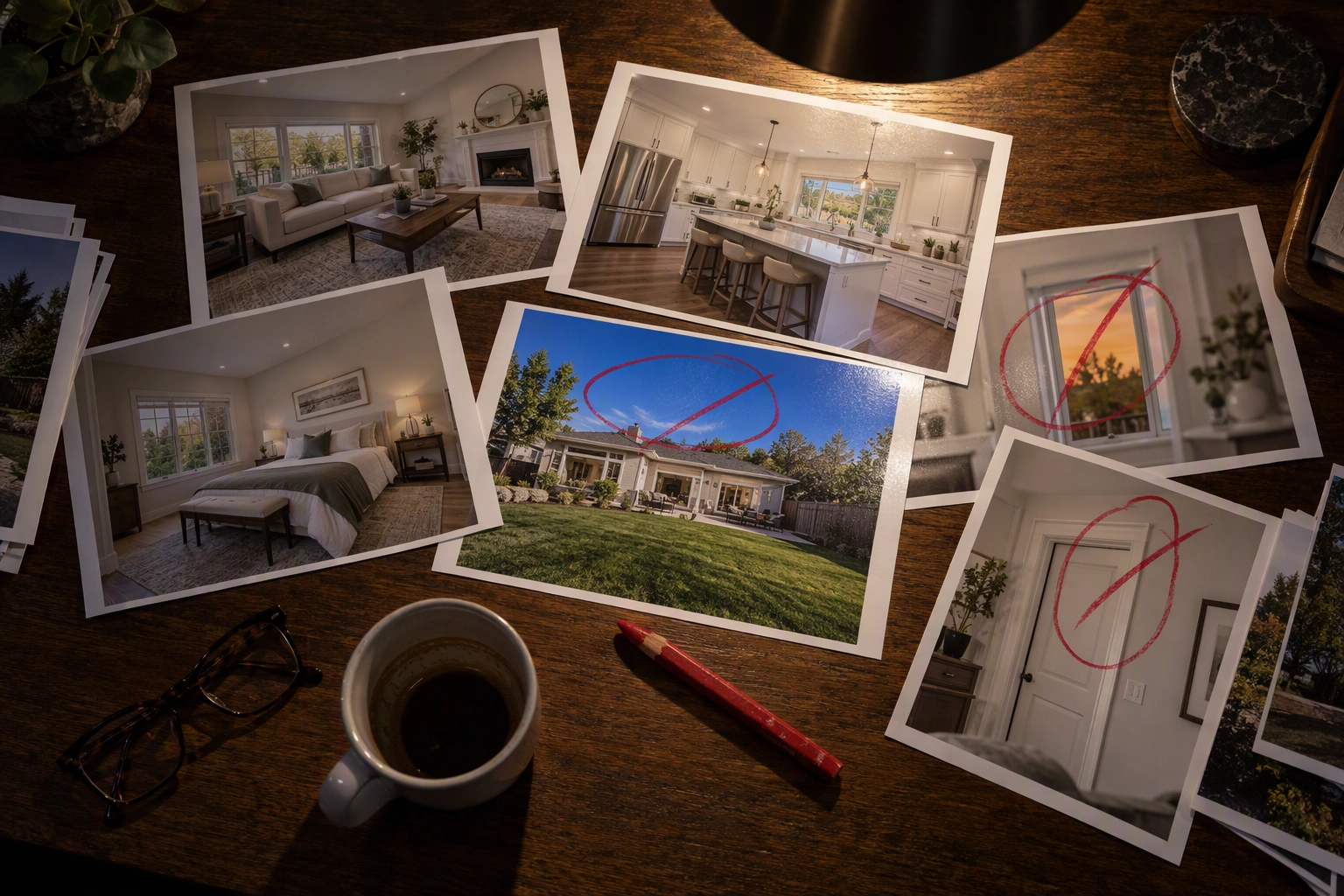
How a revision loop doubles the wait
Revisions are where outsourced timelines break. Photographers in one outsourcing thread warn that "revisions will be requested frequently," and that sets returned by editors "always require some final tweaking." Every tweak you can't make yourself becomes a ticket: mark up the frame, write the note, wait another cycle. One oversaturated sky turns a 24-hour job into a 48-hour job.
With AI, you are the revision loop. Re-running a frame takes about two minutes and one more credit; if a render comes back wrong or fails, Plotpane gives the credit back.
A shoot-day timeline, route by route
An illustrative day: 30 frames, the shoot wraps Tuesday at 3 p.m., and the agent wants the listing live Wednesday at 9 a.m. Each row uses the route's published standard turnaround.
| Route | First delivery | After one revision round | Live by Wednesday 9 a.m.? |
|---|---|---|---|
| Freelancer, 1-day delivery | Wednesday afternoon | Thursday | No |
| Per-image service, 24 hours | By Wednesday 3 p.m. | Thursday | Only with a rush tier |
| Credit service, 12–24 hours | Wednesday 3 a.m. to 3 p.m. | Wednesday night to Thursday | Maybe |
| Dedicated offshore editor | Wednesday morning, after their shift | Thursday morning | Yes, if nothing needs fixing |
| Plotpane | Tuesday, ~20 minutes after upload | Tuesday, minutes later | Yes |
Plotpane's row is arithmetic: three renders at a time, about two minutes each, so 30 frames take about 20 minutes.
The dedicated editor is outsourcing's strongest answer on delivery: working your night, they can hand back a set by morning. It's also the row with the 12-month term.
Quality variance: why outsourced edits drift
Outsourced edits drift because different people edit different frames. Distributed services route each order to whichever editor is free, so warmth, window pulls and sky choice can change between rooms of one listing, and between listings for the same client. A dedicated editor fixes this for a monthly fee; software reduces it by running one setting across a batch.

Distributed teams vs one editor
One photographer notes that most editing "teams" run 6–15+ editors, which "leads to inconsistency between properties," a real problem when you shoot for the same agent three times.
Another describes a marketplace where the "first few were good then quality fell off with multiple editors," and a service where "sky colors were off photo to photo." PhotoUp's own homepage concedes the point: "If you've tried outsourcing before you know the biggest issue is consistency."
The standard fix is a written style guide with before-and-after examples, which one photographer says "will remove most of the revision rounds." It works, but you write it, and every new editor has to learn it.
What consistency means for an AI batch
Plotpane runs one tool, one instruction and one preserve list across every frame in a batch: up to 10 photos on Starter, 50 on Pro and 150 on Agency. Nobody's taste changes between frame 3 and frame 30. It isn't a colour lock, though. Each frame renders independently, so rooms shot under different light still start apart, and consistent capture is still your job. Our batch consistency guide covers the workflow.
The preserve list also protects structure: no reinvented walls or windows, no invented views, no concealed defects.
The management overhead nobody invoices
Outsourcing moves the editing off your desk but adds a management job: writing and updating a style guide, uploading and briefing each order, checking every returned frame, writing revision notes, and re-testing when an editor leaves. AI removes the briefing, the queue and the chasing. It doesn't remove your final review.
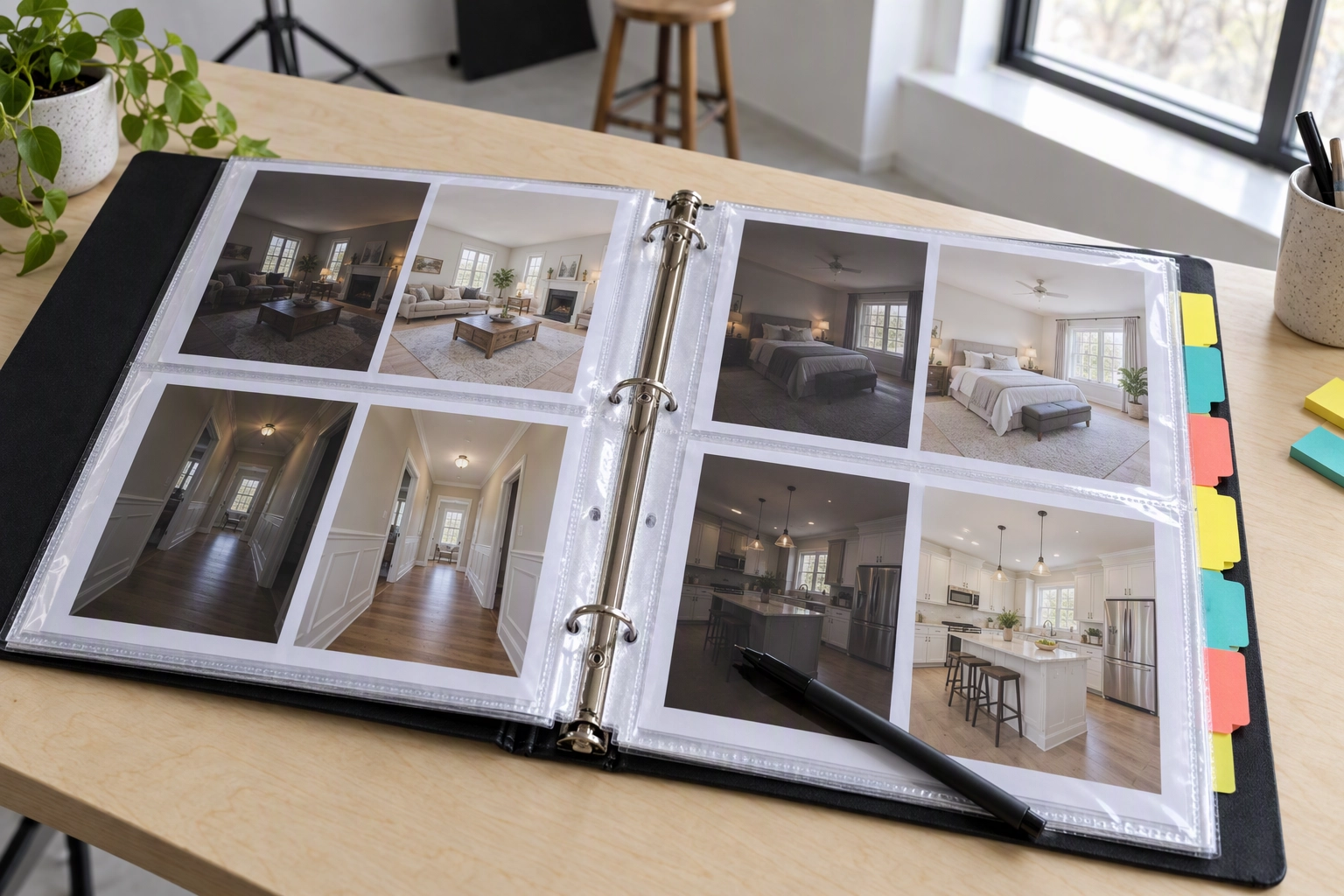
Put a number on it. Suppose briefing, checking and chasing take 20 minutes a listing (adjust to your own). At 13 listings a month that's 4.3 hours, about $93 at the BLS median photographer wage of $21.47 an hour (May 2025). With a dedicated editor, add onboarding and cover for the weeks they're off. For real estate media companies working at scale, multiply that by every coordinator who sends orders.
When a human editor still wins
Hire a human for HDR bracket blending and flambient, for composites that add content, for virtual renovation, for art-directed luxury real estate photography, and for clients who never want to open software. Plotpane is not a human-retouch service and doesn't try to be one.
HDR brackets and flambient blends
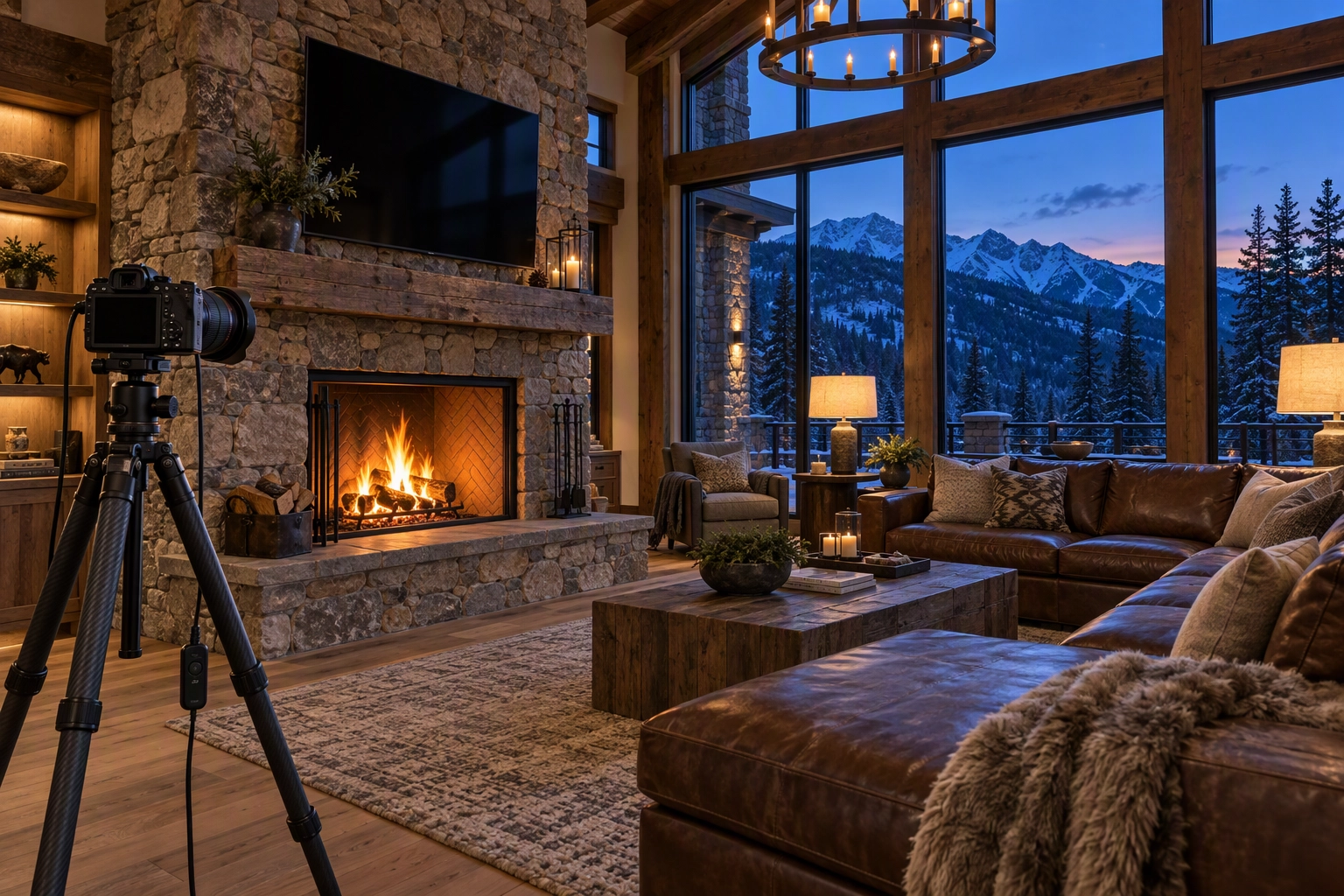
Plotpane takes one frame in and returns one frame out. It doesn't merge HDR brackets, doesn't accept TIFF, and doesn't develop raw files; it uses the camera's embedded full-size JPEG. If you shoot five-bracket HDR or flambient with window pulls, blend in your own software first or keep an editor for the blend.
Complex composites and hero shots
Fire in the fireplace, a picture on the TV, a believable view through a blown-out window, a hand-painted twilight sky for a trophy property: these are judgment calls that add content. Plotpane's preserve list forbids changing what's visible through glass, so a view replacement is human work.
No Plotpane tool repaints walls, re-tiles floors or swaps finishes either, so a virtual renovation preview belongs with a service that sells one.
Hands-off clients and video editing
If you'd rather never open editing software, a dedicated editor owns the whole edit. And if you also outsource video editing, AI photo tools don't replace that: Plotpane builds a free vertical listing reel and paid cinematic clips from finished photos, but it doesn't cut your video footage.
A decision framework: volume, consistency, control
Decide on four inputs: how many images you edit a month, what share need specialist work, how you capture (brackets or single frames), and how fast the agent needs them. Volume and specialist share set the cost; capture style and deadline set the route.
| Factor | Points to outsourcing | Points to AI |
|---|---|---|
| Monthly volume | Under ~20–35 frames | 100+ frames |
| Specialist share (dusk, staging, removal) | Rare | Several per listing |
| Capture | 3–7 bracket HDR, flambient | Single frames, phone, hand-held |
| Deadline | Next day is fine | Same day, or listings go live in the morning |
| Consistency | One dedicated editor already knows your look | Many agents or shooters feeding one brand |
| Control | You want someone else to own the look | You want to redo a frame yourself, now |
| Hero and luxury frames | Art direction, composites | Not the right tool |
| Video | Footage that needs cutting | Reels and clips from finished photos only |
Step 1: Count images, not listings
Pull last quarter's delivered real estate photography galleries and count frames. Most photographers undercount by thinking in listings.
Step 2: Tag each frame by what it needs
Standard enhancement, perspective, sky, clutter, dusk, staging, composite. The composites go to a human whatever you decide.
Step 3: Price both routes at your mix
Run the worksheet above with your own numbers. Specialist frames swing the answer more than total volume. If you're also resetting what you charge agents, our real estate photography pricing guide shows where editing fits in a package.
Step 4: Put a price on a day
If a 24-hour wait has ever pushed a listing past a weekend or cost you a repeat booking, that delay has a dollar value. Photos were the most valuable website content for 41% of buyers in NAR's 2024 Profile of Home Buyers and Sellers, ahead of detailed property information (39%) and floor plans (31%). A listing without finished photos isn't really live.
Step 5: Decide who owns quality control
Outsourcing means you manage people. AI means you review renders. Either way, someone checks every frame before it reaches the MLS. Some photographers keep editing in-house for exactly this reason: one explains they edit their own work "for full creative control and consistency in style."
The hybrid workflow most busy photographers land on
Most high-volume shooters end up splitting the work: AI for the repeatable bulk of frames, a human for the few that need a blend or a composite. Even outsourcing vendors now pitch hybrid AI-plus-human models to real estate photography and media teams, and photographers in a long thread on AI editing apps are testing the same split right now.
- Shoot single frames where you can, brackets where the room demands it.
- Blend the bracketed rooms yourself, or send only those to your editor.
- Batch the rest through Auto Enhance (50 a batch on Pro, 150 on Agency), then run Day to Dusk, Sky Swap, Lawn & Pool Revive or staging on the frames that need it.
- Send the two hero composites to a human.
- Write the disclosure line for staged or altered frames in the listing remarks.
Photographers building this pipeline can start with Plotpane for real estate photographers and the bulk editing workflow, which runs a listing in about 18 minutes of unattended rendering.
How to test both before you switch
Run the same ten frames through both routes. PhotoUp offers 5 free credits, BoxBrownie 3 free enhancements and one dusk edit, and Plotpane 3 free renders with no card (those carry a small corner mark). Compare delivery time, frames you'd send back, and the monthly cost at your real volume.
Leaving a specific vendor? Our PhotoUp alternative, BoxBrownie alternative and Pixlmob alternative pages compare them service by service.
Frequently Asked Questions
Is real estate photo editing outsourcing cheaper than AI?
Only at low volume. A $1 freelancer edit or a $2 service edit beats any subscription if you edit fewer than about 20 to 35 frames a month. Past that, a flat AI plan is cheaper, and the gap widens fast on specialist work: a staged room lists at $30 at BoxBrownie against one credit, $0.33–$0.39, on Plotpane.
How long does outsourced real estate photo editing take?
Standard real estate photo editing turnaround is 12–24 hours, with virtual staging closer to 48 and rush tiers at extra cost. Each revision re-enters the queue, so one round of changes can double the wait. An AI render takes about two minutes per image.
Is Fiverr good for real estate photo editing?
It can be. Fiverr real estate photo editing gigs start at $5 and often list around $1 a photo with one-day delivery, plus a 5.5% buyer fee and a $3.50 small-order fee under $200. Quality depends entirely on the individual seller, so test several with the same frames before committing.
Can AI replace a real estate photo editor?
For repeatable corrections on single frames (exposure, white balance, verticals, sky, lawn, clutter, dusk and staging), yes, on most listings. Not for HDR bracket blending, flambient, composites that add content, virtual renovation or art-directed hero shots. Most busy real estate photography businesses keep a human editor for those frames and video editing.
Is real estate photo retouching outsourcing safe for client files?
With any outsourcing, people outside your business see the listing and the occupants' belongings, so check the provider's data terms and NDA options. Plotpane encrypts files in storage and in transit and never uses your uploads to train its AI.
Do I have to disclose edited listing photos?
Corrections such as exposure, white balance and straightening generally don't need disclosure. Virtual staging and adding or removing elements usually do: California's AB 723 has required a disclosure and access to the original image since January 1, 2026. Plotpane writes XMP disclosure metadata into every export; the listing-remarks line is still yours. See our MLS disclosure guide.
The bottom line
Real estate photo editing outsourcing earns its fee on the frames that need a human: blends, composites and hero shots. For the rest, a 24-hour queue and a $2–$30 per-image menu are hard to justify against $39–$199 a month for renders that come back in about two minutes. Run ten of your own property photos through both, and let your numbers decide.